
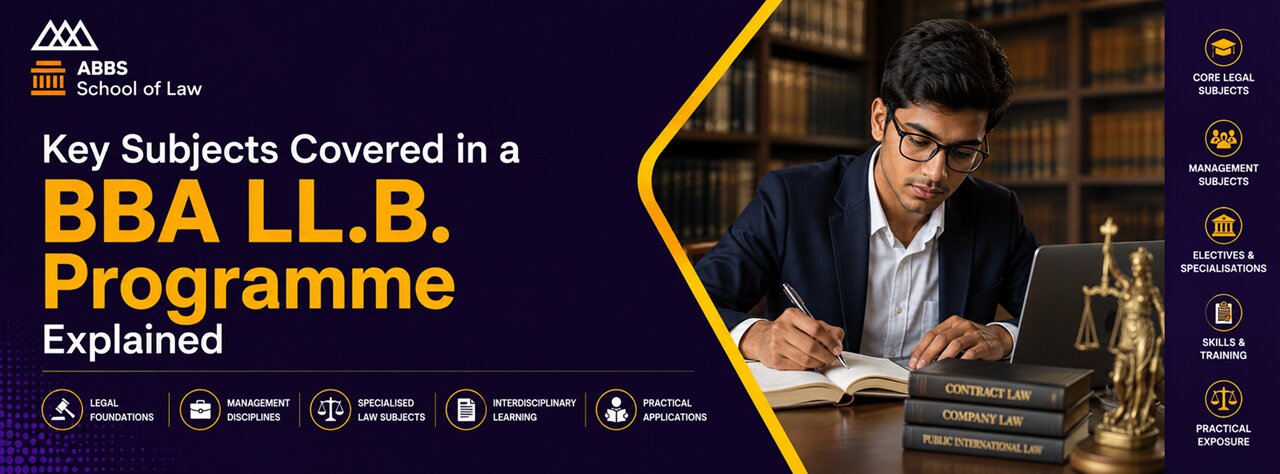
BBA LL.B. is drawing strong interest because legal careers remain stable. According to the U.S. Bureau of Labour Statistics, legal occupations are projected to grow about as fast as average from 2024 to 2034, with about 83,800 openings each year. That shows steady demand for trained legal talent.
Many students feel unsure after Class 12. They want a clear path, but law can seem broad and technical. They also want a degree that supports both courtroom and corporate careers.
This guide explains the course in a simple way. You will understand law schools, entrance exams, core subjects, practical learning, and career options. You will also see how BBA LL.B. connects law with business.
Law schools influence the way students think, read, argue and write. A law school typically incorporates lectures, case studies, homework, and practical legal education. That combination assists learners to transition between theory and practice.
In a BBA LL.B. route, the law classroom is more than just a classroom of rules. It develops critical habits and a professional voice. Students get to know about the influence of law on contracts, rights, policy, and business decisions. The broader perspective will come in handy in the future in business activities.
Most law colleges use entrance exams to select students. CLAT UG 2026 requires a 10+2 or an equivalent qualification, with 45% marks for general, OBC, PwD, and EWS candidates and 40% for SC and ST candidates. There is no upper age limit.
The exam pattern also matters. CLAT UG has 120 questions and lasts two hours. It covers English, current affairs, legal reasoning, logical reasoning, and quantitative techniques. That means students need reading speed and basic reasoning, not just memorisation.
When comparing law colleges, students should check the exam accepted, the cutoff style, and the admission process. That is especially useful for learners who plan their preparation early. A good strategy is to begin with reading practice, then move to legal aptitude and mock tests.
BBA LL.B programme is integrated five-year professional degrees. They combine legal study with management learning, so students build two skill sets at once. That structure is useful for anyone who wants both courtroom knowledge and corporate awareness.
The BBA LL.B course usually moves in phases. Early semesters focus on foundations, while later semesters add deeper subjects and practical modules. Students may study contracts, legal methods, business communication, and company-related topics alongside core law papers.
| Course feature | What it builds | Why it matters |
| Legal foundation | Legal reasoning | Supports a bachelor of law path |
| Management base | Business administration | Helps with corporate work |
| Practical modules | Case handling | Improves job readiness |
That structure makes BBA LL.B programmes attractive for students who want variety. It also supports long-term flexibility. A graduate can move toward compliance, advisory work, or business-facing legal roles.
Business administration gives the degree its commercial edge. Students learn how organisations work, how decisions affect risk, and how legal rules shape business action. That makes the degree more than a traditional law path. It becomes a legal and business programme together.
This combination is useful in many real situations. For example, a student who understands finance basics and contract law can better review vendor agreements. Another student may use management thinking to understand compliance deadlines or internal processes. That blend helps students think like professionals.
A simple way to view this integration is:
For students choosing BBA LL.B this is one of the biggest strengths. It creates a wider career base and better workplace adaptability.
The degree is comprised of core subjects. Constitutional law describes the way of functioning of the state and the way of protection of the rights. Criminal law is concerned with offence, procedure and punishment. The international law proposes rules that transcend national borders. Such topics are found in numerous mighty law curricula.
The intellectual property law has also gained prominence. IP safeguards inventions in the form of patents, copyright and trademarks to enable inventors to gain fame or gain benefit out of their inventions. This makes it very applicable in technology, branding, media and product development.
These subjects are to be treated by the students as blocks. The constitutional frame is constructed by constitutional law. The criminal law refines the analysis of the law. International law broadens the outlook. Contemporary practice areas are opened by intellectual property law. They jointly prepare students for a broad variety of law colleges and career paths.
The intellectual property law safeguards ideas, brands, designs and creative work. This has gained significance because companies are dependent on innovation and online content. That renders it a robust specialisation of contemporary legal professions.
In branding, technology, publishing, and product development, students usually come across IP law. A company might require assistance in trademarks, copyrights, or licensing. The field is applicable in other fields, not only in court.
This is a desirable area for students who like details and strategy. It also goes best with corporate law and legal advisory. In the current market, such a mix can enhance career flexibility.
One of the most effective ways of learning law through doing is moot court. It is an imitation of an actual court hearing, during which students present arguments on a problem, respond to questions, and use legal reasoning. This assists them to get out of reading and into performance.
There are a number of helpful habits developed by moot court work. Students are taught to structure facts, seek authority, articulate, and remain calm when under pressure. Those are good habits in practice and internships. They also enhance confidence when making a presentation and interviewing.
An example of this is helpful in real life: a student who practises arguments many times becomes quicker in framing issues. That pace assists in the studies and in dealing with clients. Moot court is the place where legal theory becomes a tangible thing to many learners.
Legal research is essential in bachelor of law education. It teaches students how to find the right statute, judgement, rule, or principle for a problem. Without this skill, legal writing and legal advice become weak.
Research also improves legal judgement. Students learn to compare sources, check accuracy, and understand legal context. That is important in assignments, internships, and later professional work. A strong legal research habit often separates a prepared student from an average one.
Useful research habits include:
This skill becomes especially important in busy environments. It supports clarity, accuracy, and speed. Those qualities matter in every serious legal role.
Law firms remain one of the main destinations for law graduates. They work on litigation, contracts, advisory work, compliance, and dispute handling. The legal sector also shows steady need for skilled professionals.
Many graduates also work as legal advisors. These roles may sit inside companies, consultancies, start-ups, or service organisations. Legal advisors help teams understand risk, review agreements, and avoid mistakes before they become costly.
A simple career comparison looks like this:
| Path | Daily focus | Best for |
| Law firms | Client work and case work | Students who like fast-paced practice |
| Legal advisors | Risk and contract support | Students who prefer business settings |
Both paths can be rewarding. The right choice depends on temperament, writing ability, and interest in business or dispute resolution.
Mergers acquisition work sits between law and business strategy. It involves due diligence, documentation, negotiation, and compliance checks. This area matters because business deals depend on clean legal work.
Students who enjoy commercial law often find this field appealing. It asks them to think about ownership, control, risk, and value at the same time. That means legal knowledge must work alongside business judgment.
Typical M&A tasks include:
This field is especially useful for students who want corporate careers. It shows how a BBA LL.B. can create more than one professional route. It also demonstrates why legal and business learning should be studied together.
BBA LL.B. is a strong choice for students who want both law and business learning. The course covers core subjects, practical training, and career-focused skills. It also opens paths in practice, advisory work, and corporate law.
The real value comes from preparation and consistency. Students who focus on moot court, legal research, and subject depth usually grow faster. For learners comparing options, ABBS school of Law is one to review. Talk to Expert.
RECENT POSTS
SHARE THIS PAGE