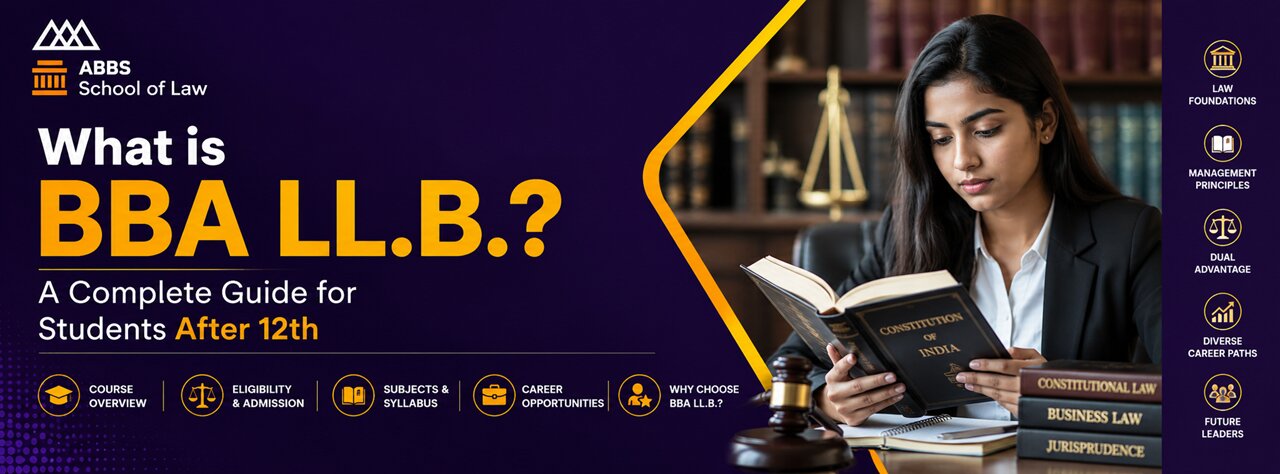
Law schools are constructed to be able to teach law as theory and practice. A school of law typically integrates classroom, case study and legal approaches to learning. That balance enables students to comprehend the way law applies in practice.
A BBA/LL.B. course comes in particularly handy as it incorporates management and law. The BBA LL.B. course is a course that integrates legal study with business management, and its outline comprises constitutional law, criminal law, corporate law, international law and practical skills.
This is because students do not study law in isolation. They also get to learn business thinking, which is useful in corporate positions in the future. To the post-12th students, that renders the degree practical and career-orientated.
Most students begin with the right eligibility criteria. For CLAT UG 2026, candidates must have passed 10+2 or an equivalent exam with 45% marks for General/OBC/PwD/EWS and 40% for SC/ST candidates. There is no upper age limit.
Entrance exams are important because they test basic aptitude. CLAT UG includes English, current affairs, legal reasoning, logical reasoning, and quantitative techniques. It is a two-hour exam with 120 questions.
A simple admission checklist helps:
Students should also compare law university admissions carefully. Different colleges may follow different selection methods. So it helps to read the official admission page before applying.
The integrated route is the easiest way to combine law and management. A BBA LL.B. is a five-year professional degree. It gives students business grounding along with legal training.
| Option | Main focus | Best for |
| BBA LL.B. | Business + law | Students who want corporate law |
| BA LL.B. | Law + social sciences | Students who prefer public law |
| BBA | Business only | Students not yet sure about law |
The difference matters because career direction starts early. If a student wants legal practice with business exposure, BBA LL.B. is a strong fit. If the goal is pure commerce, a different route may suit better.
Integrated programmes also reduce the need to switch later. That saves time and gives a clear academic path. For many students, that clarity is the biggest advantage.
The main subjects establish the law base. The constitutional laws, criminal law and international law are typically incorporated in the majority of BBA LL.B. programmes. These lessons assist students to appreciate the state, rights, offences and the international legal systems.
The fundamental form of government is taught by constitutional laws. The criminal law describes offences, procedure, and punishment. International law brings forth regulations between nations and international bodies.
| Subject | What it covers | Why it matters |
| Constitutional laws | Rights, duties, governance | Foundation of Indian law |
| Criminal law | Offences and procedure | Core for litigation |
| International law | Global legal rules | Useful for cross-border work |
These subjects are not just academic topics. They shape how lawyers think and argue. They also prepare students for internships and professional conversations.
One of the most beneficial aspects of legal education is moot courts. They pretend to have a court hearing in a controlled environment. Students argue cases, cite law and answer questions.
Many colleges claims that its instruction approach involves moot courts and project assignments. That is how law schools relate theory and practical appreciation.
Moot courts assist students to develop the following:
A student who participates regularly usually improves quickly. The experience also helps in internships and interviews. That is why moot courts matter so much in law schools.
Legal research is the backbone of legal practice. It helps students and professionals find the right statutes, judgments, and principles. Without it, arguments become weak and incomplete.
A lot of colleges places major emphasis on legal and policy research. Its research centres and journals support deeper legal thinking.
Good legal research improves:
This is especially useful in the real world Clients expect precise answers, not broad guesses. So legal research is not optional. It is essential.
Legal practice offers many career paths after BBA LL.B. Graduates can join litigation, corporate teams, compliance units, or advisory work. Legal occupations are projected to grow about as fast as average from 2024 to 2034, with about 83,800 openings each year in the US. That shows the field continues to need trained professionals.
Top law firms often work with commercial clients. They handle contracts, disputes, regulation, and transactions. That makes them a strong option for law graduates who enjoy fast-paced work.
Typical career paths include the following:
These roles reward discipline and clear writing. They also suit students who like structured problem-solving. For many graduates, law firms become the first major step.
Many graduates work inside companies rather than courts. Legal departments handle contracts, compliance, internal policies, and dispute support. That is where legal advisors become especially important.
In this route, law is tied closely to business needs. The work may involve reviewing agreements, checking risks, or supporting management decisions. It is steady, detail-oriented, and commercially relevant.
This path suits students who like:
Many students prefer this route because it combines law with office-based work. It also opens doors in banking, tech, retail, and consulting. That makes it a flexible career choice.
Mergers and acquisition work sits at the centre of corporate law. M&A is a major area of practical legal work. Lawyers handle deal structuring, regulations, and transaction documents.
This specialisation needs more than legal memory. It needs business sense, negotiation skill, and careful reading. That is why BBA LL.B. students often find it attractive.
A simple M&A workflow looks like this:
Students who enjoy commercial law often move toward this area. It is one of the strongest examples of law and business working together.
Law and business integration gives students more than one direction. It helps them understand contracts, management, finance, and regulation together. That makes them useful in both legal and corporate settings.
The strongest students usually build their careers step by step:
This mix creates confidence and employability. It also helps students move between legal practice and business roles. That flexibility is one of the biggest strengths of BBA LL.B.
For students exploring this path after 12th, ABBS school of Law can be one college to review. Talk to Expert.
RECENT POSTS
SHARE THIS PAGE